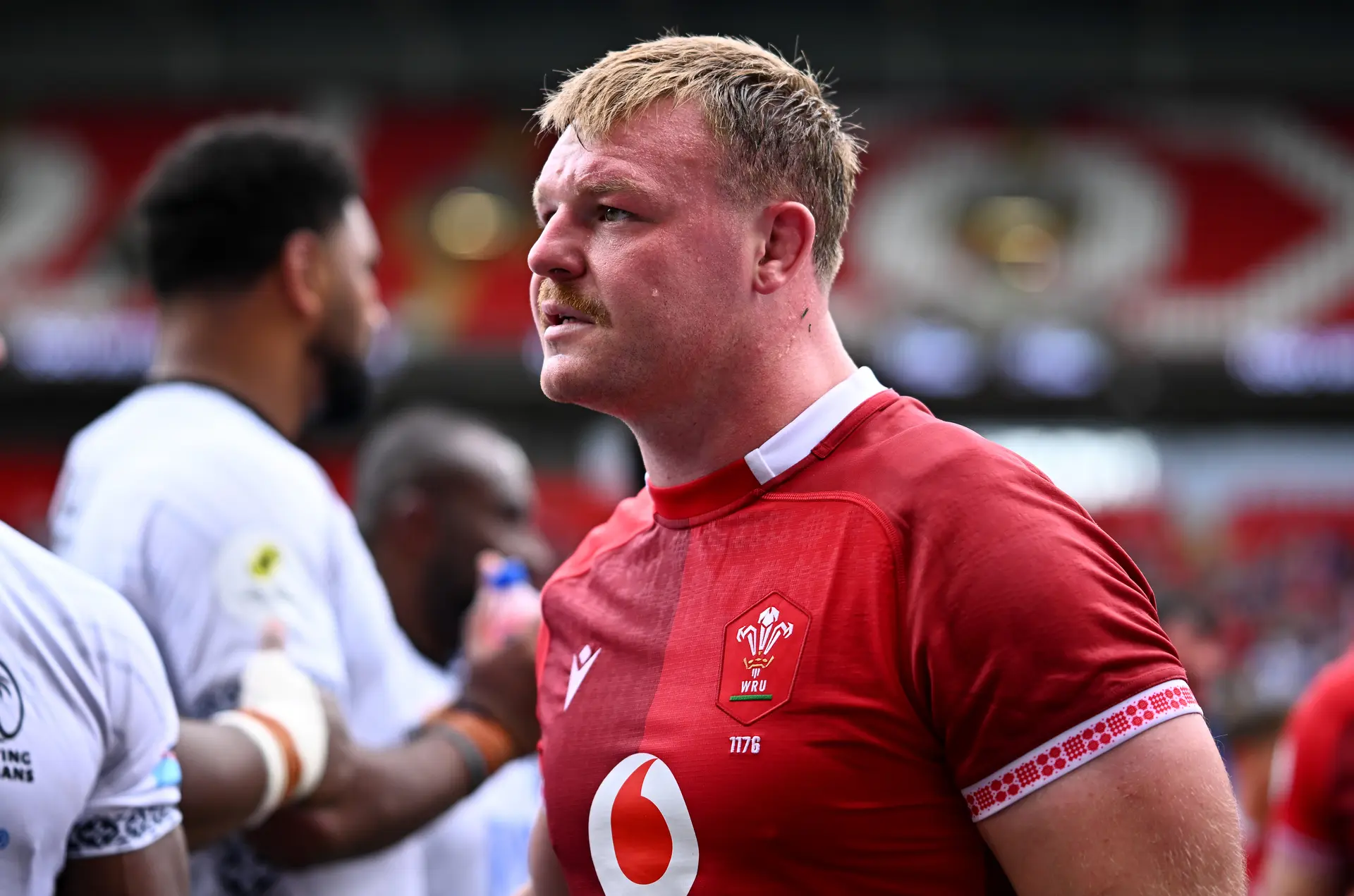

The challenge that lies ahead for Wales against Argentina is unlikely to be any easier than the encounter against Fiji last Saturday at the Cardiff City Stadium.
Even in that 39-24 victory last weekend, there were enough defensive green shoots to suggest that Wales are starting to improve on the international stage.
’, so that’s why the strategy currently being employed is one that has time to develop, but needs to do so quicker than other campaigns.
⭐ Save us to your Google Favourites for nonstop RUCK content!
This arrives on the back of two straight Test wins, including an uncapped triumph against the Barbarians; Steve Tandy’s side is starting to build momentum, and now has the results to back up positive displays.
Something they were showing in the Six Nations but were unable to record results against Scotland and Ireland, despite the mood surrounding the Welsh men’s senior side changing.
It’s simple: the contest against Fiji, if it had come 12 months earlier, Wales would not have won, brutal but true. That’s how much progress Wales has made under Tandy in such a short period.
They are by no means the finished article, but with the 2027 Rugby World Cup in Australia on the horizon, Wales are building nicely towards that tournament.
Against Fiji, Peter Murchie's first competitive game as Wales’ defence coach was far from flawless, but it still showed signs of encouragement. Wales missed 39 tackles and finished the game with an 81 per cent tackle completion rate.
On the impact of the new defence coach, Cardiff Rugby’s Josh Adams added: “The Baa-Baas must be a horrible (game) as a defence coach, because it’s literally the unknown. You haven’t got a clue what they are going to throw at you.
“Those weeks, you sort of focus on yourselves as best you can. Then, Fiji, you will not face a team that can do things with the ball offloading-wise. Athletes, how good are they as athletes?
“He’s (Murchie) brought some nice detail around our edge stuff. Still think we are getting to grips with a bit of it, but he has been a great addition.”
“Building and adding detail to some of our fundamentals that we had in the Six Nations,” added second row Ben Carter on the influence of Murchie.
“Bringing that accountability and things. (He’s) just adding layers of detail- that’s what I found so far.
“It doesn’t feel like a massive change; it’s not like we are starting again. It’s very much just building.
“Probably three fundamental principles (in defence), which is quite good for keeping sort of clarity in your mind, in a Test match when the pressure is there, and there’s fatigue.
“You can just go back to three fundamentals. They're still there; it’s just about building the detail and knowledge around that with Murch coming in.”
Statistics on these figures would normally point to a side destined for defeat, as would have been Wales' case. In England’s 45-21 defeat against South Africa in Johannesburg, Steve Borthwick’s side missed 30. Italy, in their 27-10 defeat to Japan in Tokyo, missed only 13. France’s narrow 34-32 loss against New Zealand, they missed 27.
You get the picture, and that leaves one blatant question: how did Wales actually win a Test match missing so many tackles?

CARDIFF, WALES - JULY 04: Dewi Lake, Adam Beard and Jac Morgan of Wales sing the national anthem prior to the 2026 Nations Championship match between Fiji and Wales at Cardiff City Stadium on July 04, 2026 in Cardiff, Wales. (Photo by Alex Livesey - Nations Championship/Nations Championship via Getty Images)
In the first half alone, Wales missed 31 tackles but went in at the break level at 10-10 after a brace from Player of the Match Jac Morgan. In the opening 40 minutes, Fiji missed only three. It’s just another example of yet again, statistics rarely tell the full story.
On the changes made at halftime against Fiji, wing Adams said: “It’s honestly so hard, because you get caught between going high to try and stop the offloads to defend the ball.
“But if you don’t get a good first-up collision, they are so strong and powerful you’re going backwards anyway. We didn’t narrow it up, but we had a better mindset around it.
“First guy, we win the collision first. Hit hard first, and then that second tackler will be the one to affect the offload, get his hand in the way, or get a strip.
“I also thought we competed a lot better on the floor for the ball in the second half. I don’t know how many jackal turnovers we got, but we got some quite high up the field as well, which is really important.”
Fiji threw everything at Wales, carrying the ball 148 times for 403 post-contact metres and producing 10 line breaks to Wales’ three. In comparison, Wales barely saw the ball, managing just 79 carries for 156 post-contact metres, but scored six tries for the first time since 2021; they did so that day against Fiji too.
Wales captain Dewi Lake said on his side’s improvements following the constant onslaught from Fiji: Was it tackle height? Was it a tackle choice? What did Wales change at the break?
“For us, it was probably the support players around the tackler; we spoke about getting closer, to even stop offloads,” he said.
“Steve talks about tracking those offloads; I think we’re probably a little bit loose in terms of our work when you’re not involved in the tackle.
“It was a big message at halftime for us; even if you’re not involved, you’re still playing a key part in stopping that game.
"So, I think probably saw more boys working harder around the tackle area as well. That was a big change for us.”
Wales made only three line breaks, yet this staggering statistical imbalance, which frankly should not warrant a victory, shows that the long periods spent defending against one of the most flamboyant sides in international rugby was worth it in the end.
Whilst the opening 40 minutes showed Wales’ flaws and vulnerabilities, after the break Wales recovered their shape and repeatedly found a way to stay ahead, which again shows progression.
Pleasing for attack coach Matt Sherratt, not so much for Murchie. Wales’ attack was always hitting perfection, but when three of your six crosses come from a set-piece driving maul, it paints more of a clearer picture.
After leaving Buenos Aires on Thursday evening, Murchie will have undoubtedly had no shortage of clips to review before arriving in San Juan.
To be successful against Los Pumas, the missed-tackle stat must come down, and their defensive system needs to improve significantly, as they are coming up against a side, albeit coming off a 47-38 defeat to Scotland, that will still test Wales with greater structure and accuracy than Fiji.
Wales has plenty of positives, having shown resilience in defence and refusing to back down. Whilst the chaos of both the Baa-Baas and Fiji tested Wales through broken-field play to start their summer campaign, you do feel that if Argentina are given opportunities, they will likely punish.
Facing Argentina will tell Wales head coach Tandy exactly where his side is at, as, without doubt, planning for next year’s World Cup has already begun.
Ireland head coach Andy Farrell said post-match following his side's 33-31 victory against Australia in Sydney, 'everyone has got an eye on what’s coming up
Wales need to be sharper in their execution from the off.
It’s a long way, 7,000 miles, to travel for Wales for just one single Test match, but the players have arrived in South America, and with the second-half performance against Fiji a huge boost, why can’t Wales replicate that against Argentina?
LATEST RUGBY NEWS
TRENDING





LATEST NEWS
LATEST COMMENTS
Loading