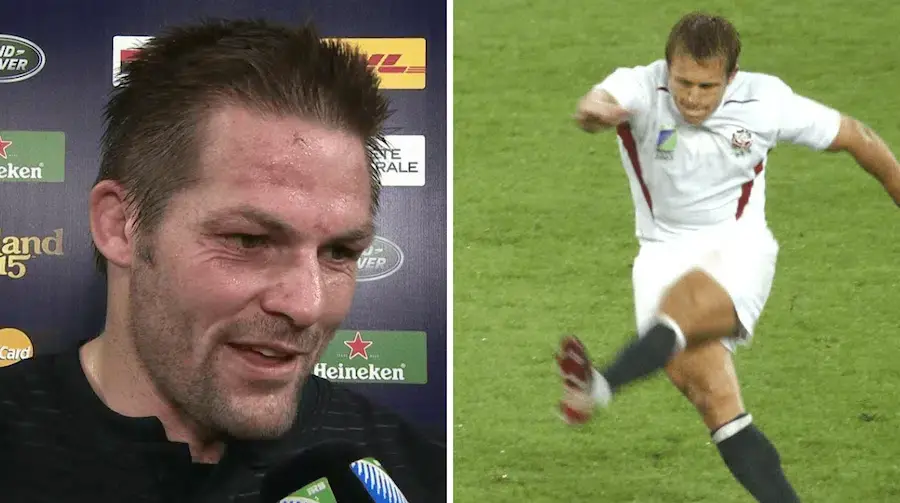

The Rugby World Cup is the pinnacle competition for the international game, and the biggest moments often call for the world's best players to shine.
Throughout the competition's 36 year history there have been some truly iconic players, who performed at their very greatest when the Web Ellis Trophy was on the line. Picking the top five of this impeccable group is a definite challenge, as there are so many top contenders to be considered throughout the Rugby World Cup's decorated history.
The world-beating talents of Francois Pienaar, Martin Johnson, Dan Carter and Bryan Habana are all deserved of honourable mentions, yet they fall short of this illustrious top five. Despite all being undisputed legends in their own rights, there is only room for five on this uber-refined list of the Rugby World Cup's best ever players.
Get your tickets for the 2023 Rugby World Cup at viagogo, the world’s leading ticket marketplace.
5. David Campese
The great entertainer, every time David Campese got the ball in his hands for Australia, Wallabies fans got out of their seats. Regarded as one of the greatest wingers in rugby history, 'Campo' was a revered opponent the world over, with his fabled goose step wrong-footing the most renowned tacklers.
Arguably the originator of modern-day footwork, Campese's elusive talents inspired a generation of fleet-footed steppers to the global game. Campese became the first Wallaby, and second ever player to make 100 test match caps. He retired after his 101st cap, with a then world record of 67 test match tries to his name.
Campese was a true box-office draw, with his exciting attack showcased best on the Rugby World Cup stage. An integral part of Australia's maiden Rugby World Cup voyage in 1987, Campese led his side to an opening victory over England, which featured his 'controversial' assist for Michael Lynagh's try. Campese scored against the USA, Japan and then his world-record equalling 25th test match try against France.
Australia were ousted by a phenomenal 'Les Bleus' side in the 1987 semi-final, with Campese's crowning competition coming four years later at the 1991 Rugby World Cup. The winger scored six tries in six games, and was awarded the top-try scorer award, as the Wallabies lifted the Web Ellis Trophy for the first time in their history.
Campese's masterclass performance in the semi-final eliminated the All Blacks, and felled their hopes for back-to-back Rugby World Cup titles. Another impeccable outing in the final saw Campese lead from the front, as England could not contain the exhilarating winger, who went on to be named the Player of the Tournament for the 1991 Rugby World Cup.
England would gain revenge on the Wallabies in the 1995 Rugby World Cup quarter-finals, with Campese present once again. The 'Australian Invincible' had unrivalled longevity in the famous gold shirt, and was consistently at the heart of the action for Australia.
4. Jonah Lomu

Rugby's first true superstar, who helped grow the game into the global attraction that it is today. The late, great Jonah Lomu transcended rugby to the point where he is undeniably in contention amongst the greatest athletes of any sport. The powerhouse winger was a true force of nature, when he first burst onto the scene in 1995.
Lomu enters this list as the only player to not win the Rugby World Cup, which speaks volumes of his impact upon the global game. A pioneer for the sport, Lomu attracted new fans, sponsorships and media attention to rugby union, as the face of the 1995 and 1999 Rugby World Cups. Despite only making two All Blacks caps before the 1995 competition, the rugby world was soon swept into a frenzy over New Zealand's unstoppable winger.
The All Blacks legend scored seven tries in five matches at the 1995 tournament, with his debut World Cup appearance against Ireland fondly remembered for two great scores. Lomu could trample his way over defenders, or explode past the opposition with unmatched pace. He scored four tries against England in the semi-final, with his most famous score iconised in the image of a flattened Mike Catt.
After a closely-contested final, the All Blacks were defeated by the Springboks thanks to the accurate boot of Joel Stransky. However Lomu's status as rugby's almighty megastar only grew, and led to the sport's commercial growth. The ground-breaking 'Jonah Lomu Rugby' PlayStation video game was adored by fans upon it's release in 1997, as the All Blacks hype reached a fever-pitch ahead of the 1999 Rugby World Cup.
Lomu scored a further eight tries at the 1999 Rugby World Cup. The colossal winger ran in two against Tonga, Italy and France, and one each against England and Scotland. Despite Lomu's best efforts by scoring a brace in the semi-final, it was Les Bleus who claimed the accolade of knocking out the much-fancied All Blacks from that year's competition.
Despite only appearing at the Rugby World Cup in two tournaments, Lomu finished his international career as the competitions all-time leading try scorer. Lomu's immortal 15 tries has since been equalised by legendary Springbok winger Bryan Habana. However Lomu's accomplishment is considered even more impressive, as Habana needed to play in one additional Rugby World Cup (2007, 2011 and 2015) to match Lomu's record.
3. Jonny Wilkinson
The provider of the most iconic moment in England rugby history, Jonny Wilkinson's heroics at the 2003 Rugby World Cup will forever be remembered. Slotting the decisive drop goal with his weaker right foot, Wilkinson sent the ball sailing through the Sydney air, as England triumphed over the Wallabies for their only Rugby World Cup title to date.
Yet Wilkinson is anything from a one-moment man, the legendary fly half makes this list for his longevity for England with each Rugby World Cup appearance highlighting a unique era in the life of Wilkinson. In 1999, 'hot-shot' was a fresh-faced 19-year-old, who had sky-rocketed to the international stage. He fearlessly marked his World Cup debut with 32 points, as he scored a try, kicked six conversions and nailed five penalties against Italy.

In 2003, Wilkinson was a world-beater in his prime. After captaining England for the first time in the 2003 Six Nations Grand Slam triumph, England headed to the Southern Hemisphere for a pre-Rugby World Cup tour. Wilkinson scored all of England points, as they despatched the All Blacks 15-13, and was instrumental in securing England's first victory over the Wallabies on Australian soil, a spoiler for the upcoming final that year.
Then the 2003 Rugby World Cup arrived, and England were rightfully amongst the favourites. The intense national pressure motivated Sir Clive Woodward's side, and Wilkinson dealt with the newfound celebrity status in his unique way. Leading his side to blistering victories in the pool stages, England marched on eliminating Wales and France in the knock-out matches. The final against Australia is that of rugby folklore, and is the definite high for Wilkinson's career.
The fly half still had far more to give, and was a pivotal experienced player for England at the 2007 and 2011 Rugby World Cups. Recovering from an ankle injury to lead his side once again in '07, Wilkinson slotted his long-forgotten other drop goal, sealing the semi-final victory over France from 40 yards out. Wilkinson become one of only four England players to play in the 2003 and 2007 RWC finals, as they suffered defeat to the Springboks. Wilkinson made history, as the (then) only player to score points in two Rugby World Cup Finals.
Wilkinson's Rugby World Cup swansong in 2011, saw the fly half take up a wise veteran role. An inspirational figure amongst the camp, 32-year-old Wilkinson guided Toby Flood at the showcase event. England were knock-out by finalists France in the quarter-finals, with Wilkinson bidding farewell as the Rugby World Cup's highest points scorer, with 277 points throughout 16 years.
2. John Eales
The man who was nicknamed 'Nobody', because as they say, 'Nobody's perfect'. The former Queensland Reds star was the most successful captain in the history of the Wallabies, and is amongst a select few of rugby's elite to win the Rugby World Cup on two separate occasions.
Australia's glory days throughout the 1990s saw the Web Ellis trophy head to the land down-under in 1991 and 1999, with John Eales playing an key role in both victorious tournaments. There was nothing that Eales could not do, he played in the second row, and occasionally starred at number eight, with a masterful touch from the boot.
Never before had rugby seen a forward with such kicking prowess, as Eales slotted 34 penalties and 31 conversions for the Wallabies. He is the 12th highest point-scorer for the Wallabies, with his two tries building a total of 173 points (one try was awarded four points prior to modern rule changes). Irrefutably, Eales is the highest scoring forward in test match rugby history.
There is an asterisk amongst his captaincy honours, as he has 60 recorded caps for the Wallabies whilst wearing the invisible armband. However, only 57 of these were official test matches, meaning George Gregan scrapes to top spot for this accolade with 59 captaincy appearances. However, regardless of the statistics, Eales' starring role as Wallabies captain was the definitive driving force behind his side winning the Rugby World Cup in 1999.
Australia ran roughshod on their Pool E opposition in 1999, handing Ireland, Romania and the USA heavy defeats. Eales' leadership qualities were shown at full strength in the quarter-final clash with Wales, as he was able to steer his side to victory despite the 72,000 predominantly Welsh fans concocting a deafening atmosphere in Cardiff's Principality Stadium.
Eale's work-rate was famously unmatched. The lock would never stop, and often left every fibre of his being out on the pitch in pursuit of victory. Be it a tackle, a carry or hitting a ruck, Eales would give that extra 10% which would outlast his fatiguing opponents. This attribute was never showcased better than in Australia's extra-time semi-final victory over the Springboks.
A try-less fixture that was one for the rugby purists, Eales led his side to war against the 'Boks, with Matthew Burke and Stephen Larkham contributing the decisive points from the boot. Then the final arrived, and Eales utilised his previous Rugby World Cup winning experience to orchestrate a triumphant gameplan for the Wallabies, who dismantled France 35-12.
1. Richie McCaw

LONDON, ENGLAND - OCTOBER 31: Richie McCaw of New Zealand lifts the trophy after victory during the 2015 Rugby World Cup Final match between New Zealand and Australia at Twickenham Stadium on October 31, 2015 in London, United Kingdom. (Photo by David Rogers/Getty Images)
The only man to captain a team to back-to-back Rugby World Cup titles. Considered to be the very best rugby player to ever lace a pair of boots, Richie McCaw is rightfully awarded top spot on this list of the Rugby World Cup's greatest ever players.
McCaw made his Rugby World Cup debut in 2003, after being named Super Rugby 'Newcomer of the Year' for the Crusaders a year prior. At just 21-years-old McCaw had already stamped his name on the All Blacks number seven jersey, and played in every match of the '03 tournament, before being eliminated by Australia in the semi-final.
This coming-of-age competition worked wonders for a young McCaw, who after the international retirement of Tana Umaga, was named All Blacks captain in 2006; a mantle he held for nine years, across three Rugby World Cups. Admittedly, McCaw's inugural World Cup as captain did not go to plan, as the All Blacks were eliminated by France in the quarter-final, for the nations earliest ever World Cup exit.
However, McCaw was not at fault. All Blacks Head Coach Graham Henry tampered with his side on too many occasions, limiting his side's captain to just two starts and one substitute appearance which hindered the consistency of the on-field leadership.
However 2011 made for a different story, with McCaw firmly entrusted at the reigns. Graham Henry was made to recognise the flanker's talents, helped in no end by Steve Hansen being appointed to Assistant Coach of the All Blacks. This began eight years of All Blacks domination, with Richie McCaw leading his side to success at every turn.
Recovering from a foot injury in time for the 2011 tournament, McCaw earned his 100th All Blacks test cap against France. New Zealand dominated the Pool stage opposition, with expectations high for the nation's first title since 1987, made ever more appealing on home soil. Confident knocko-out victories against Southern Hemisphere rivals Argentina and Australia set up a re-union with France in the 2011 final. This gruelling match saw McCaw clash with French captain Thierry Dusatoir, before toppling les Bleus in a sweet act of world cup revenge.
McCaw repeated the feat in 2015, leading the All Blacks to retain their title as world champions in a never-before-seen accomplishment. The fairy-tale 2015 final was McCaw's final act as an All Black, as he along with Dan Carter, Ma'a Nonu, Conrad Smith, Kevin Mealamu and Tony Woodcock bowed out on the international stage, marking the end of an era for the black jersey.
The 2015 victory over the Wallabies optimised a full circle closure in rugby story-telling. Ma'a Nonu ended his All Blacks legacy with one of his greatest ever tries, Dan Carter made up for his 2011 injury, and dropped a pivotal drop goal to turn the momentum of the game, and McCaw made history as the (then) most capped international player of all time, as he made his 148th test match, and 111th as captain.
Alun Wyn Jones has since surpassed McCaw's test cap record with 170 (158 for Wales, 12 for British Lions). But McCaw's legacy is best immortalised in the one-true accolade, of being the only rugby player in history to win back-to-back Rugby World Cups as captain. This solidifies his claim as the greatest ever Rugby World Cup player, with the record possibly set to stand the test of time.
TRENDING

LATEST NEWS
LATEST COMMENTS
Loading