The 5 Best Springboks Victories over the All Blacks: Rugby's Greatest Rivalry
Rugby NewsFriday, 21 August 2026 at 07:55

By Thato Phala
There are rivalries, and then there is the Springboks versus the All Blacks.
Join the RUCK’s WhatsApp community here and get the latest news sent straight to your messages.
For well over a century, South Africa and New Zealand have produced some of the greatest contests in rugby history, with both nations repeatedly pushing each other to extraordinary heights. As we await the first test match this weekend in Rugby's Greatest Rivaly series, it's time to re-visited some of the greatest wins from the men in green and gold.
Choosing the five greatest Springboks victories is almost impossible, with countless classics spanning generations. But these five stand above the rest for their quality, significance and lasting impact on South African rugby.
5. New Zealand 11-12 South Africa – Rugby World Cup Final, 2023
The closest of victories on rugby's biggest stage. If the 1995 World Cup final represented the beginning of a new South Africa, the 2023 final showed just how far the Springboks had come.
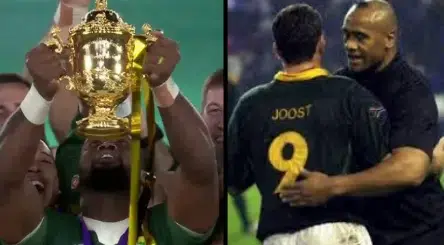
Nearly three decades after Nelson Mandela and Francois Pienaar produced one of the most iconic moments in sporting history, South Africa and New Zealand met again in a World Cup final at the Stade de France. This time, the Springboks were attempting to become the first nation to win the Webb Ellis Cup four times, while New Zealand were chasing a record-equalling fourth title.
It was a final dominated by tension rather than tries. Handré Pollard was the Springboks' hero, kicking all 12 of South Africa's points through four successful penalties. He opened the scoring after just three minutes before adding further penalties in the 13th, 19th and 34th minutes. Richie Mo'unga replied with two penalties of his own as South Africa took a 12-6 lead into half-time.
But the match descended into chaos. All Blacks captain Sam Cane became the first man to recieve a red card in a Rugby World Cup Final, before Springboks skipper Siya Kolisi was shown a yellow card for a high tackle on Ardie Savea, leaving South Africa temporarily down to 14 men. New Zealand thought they had scored through Aaron Smith, only for the try to be ruled out after Ardie Savea was judged to have knocked the ball on.
The All Blacks eventually found their breakthrough when Beauden Barrett crossed in the 58th minute, but Mo'unga missed the conversion, leaving New Zealand one point behind at 12-11. With seven minutes remaining, Cheslin Kolbe was also sent to the sin bin for a deliberate knock-on, giving the All Blacks another opportunity to steal the title.
They could not take it. South Africa held on through a frantic final period to secure a 12-11 victory, becoming the first nation to win the Rugby World Cup four times and only the second - after the world-beating All Blacks of the 2010s - to successfully defend the fabled Web Ellis Cup.
The individual performances were immense. Pieter-Steph du Toit was named Player of the Match after making 28 tackles, while Pollard's perfect goal-kicking kept the Springboks ahead on a night when there was no room for error. The victory also added another extraordinary chapter to the Springboks-All Blacks rivalry. It was the first time the two nations had met in a Rugby World Cup final since 1995 — and, once again, South Africa walked away with the gold.
Twenty-eight years after Mandela handed Francois Pienaar the very same trophy, the Springboks had beaten the All Blacks in another World Cup final. This time, there was no fairy-tale drop goal or late drama to separate them — just 80 minutes of brutal Test rugby decided by a single point.
4. New Zealand 34-36 South Africa – Wellington, 2018
The night the Springboks announced their return. Few Springboks victories in New Zealand have carried the emotional weight of the 2018 Wellington classic.
South Africa arrived at the Westpac Stadium having suffered a humiliating 57-0 defeat to the All Blacks in Albany the previous year. Questions were being asked about the direction of South African rugby, but Rassie Erasmus had begun the process of rebuilding the team.
Wellington became the moment that rebuild suddenly looked very real. New Zealand raced into a 12-0 lead through Jordie Barrett and Aaron Smith, but Aphiwe Dyantyi responded with the first of his two tries before Willie le Roux and Malcolm Marx put the Springboks firmly in control. Cheslin Kolbe then produced one of the defining moments of the match, intercepting an Anton Lienert-Brown pass and sprinting 40 metres to score.
Dyantyi completed his brace as the Springboks built a 36-24 advantage, but the All Blacks refused to go quietly. Codie Taylor and Ardie Savea scored late tries to reduce the deficit to two points. With the clock running down, New Zealand had one final opportunity.
The Springboks survived 16 phases of pressure on their own line, before Damian McKenzie knocked the ball on as the All Blacks searched for the winning score. South Africa had done it. The 36-34 victory was their first win in New Zealand since 2009, and it represented a major psychological shift in the rivalry. The Springboks were back.
3. South Africa 46-40 New Zealand – Ellis Park, 2000
10 tries, 86 points and complete chaos.
If one match captures the sheer unpredictability of the Springboks-All Blacks rivalry, it is this one. Ellis Park produced an extraordinary attacking spectacle in 2000, with South Africa scoring six tries and New Zealand responding with four in an 86-point thriller.
Robbie Fleck was the star of the opening half, scoring twice as the Springboks raced into a 33-13 lead. Chester Williams and Werner Swanepoel also crossed, while Thinus Delport added another try. But the All Blacks had Christian Cullen and Tana Umaga.
Cullen scored twice, including the try that made him New Zealand's leading Test try-scorer at the time, while Umaga also crossed twice. Andrew Mehrtens added four conversions, three penalties and a drop goal as New Zealand repeatedly threatened to turn the match around. Swanepoel's second try ultimately helped the Springboks hold on for a 46-40 victory.
The result was more than a high-scoring victory, as it showcased two teams willing to attack relentlessly, and it remains one of the highest-scoring matches in the history of the rivalry. Ellis Park had witnessed some extraordinary Springboks-All Blacks battles before — but this one was pure rugby theatre.
2. South Africa 35-7 New Zealand – Twickenham, 2023
The warning shot before another World Cup triumph. Just weeks before the 2023 Rugby World Cup, the Springboks delivered a performance that sent a message to every team heading to France.
South Africa demolished New Zealand 35-7 at Twickenham, handing the All Blacks the heaviest defeat in their history at the time. The Springboks were relentless from the opening whistle.
Siya Kolisi scored first before Kurt-Lee Arendse crossed to establish a 14-0 half-time advantage. The All Blacks were dealt another huge blow when Scott Barrett received a red card after two yellow cards, leaving New Zealand with 14 players.
Malcolm Marx then scored immediately after the restart before Canan Moodie, Bongi Mbonambi and Kwagga Smith completed a five-try demolition. Manie Libbok converted all five Springboks tries. Cam Roigard eventually scored a consolation try for New Zealand, but the damage had already been done.
The Springboks had dominated the collisions, destroyed the All Blacks at scrum time and repeatedly overwhelmed their rivals at the set piece. And the significance became even greater in hindsight. South Africa went on to win the Rugby World Cup in France, as they defeated New Zealand to retain their title as World Champions.
Twickenham had provided the first major psychological blow of a World Cup year — and the Springboks had delivered it emphatically.
1. South Africa 15-12 New Zealand – Rugby World Cup Final, 1995
The match that transcended rugby. There could only ever be one choice.
The 1995 Rugby World Cup final was more than a match between the Springboks and All Blacks. It became one of the defining moments in South African history. Just over a year after the end of apartheid, South Africa hosted the World Cup knowing the tournament carried significance far beyond the rugby field.
Standing between the hosts and the Webb Ellis Cup was a New Zealand side containing one of the most feared players the game had ever seen: Jonah Lomu. Yet the Springboks found a way to stop him.
Ruben Kruger, Mark Andrews, Joost van der Westhuizen and Japie Mulder were among those who repeatedly denied Lomu the space he needed to unleash his extraordinary power. The final remained tryless, with the points coming through the boot.
Andrew Mehrtens and Joel Stransky traded penalties before Stransky's 22nd-minute drop goal gave South Africa a 9-6 half-time lead. Mehrtens levelled the contest with a drop goal in the second half before extra time became inevitable, as the All Blacks maestro missed a decisive shot at goal. New Zealand edged ahead through another Mehrtens penalty in extra time.
Then came Stransky. The Springboks fly-half calmly struck the winning drop goal to secure a 15-12 victory and the first Rugby World Cup in South African history. And then came the image that would define the occasion. Nelson Mandela walked onto the field wearing Francois Pienaar's No. 6 Springboks jersey and presented the Webb Ellis Cup to the captain.
The photograph became one of the most recognisable images in sporting history. For the Springboks, it was a World Cup triumph. For South Africa, it was a moment of unity and reconciliation. And for the rivalry, it created one of its most powerful chapters.
Tomorrow, at this very same Ellis Park stadium, South Africa and New Zealand will meet again. Another chapter is about to begin.
LATEST BY THATO PHALA
LATEST RUGBY NEWS:
TRENDING

LATEST NEWS
LATEST COMMENTS
Loading