Duhan van der Merwe Responds to Talk of Springbok Move Amid Scotland Exile
Rugby NewsSaturday, 14 March 2026 at 07:57
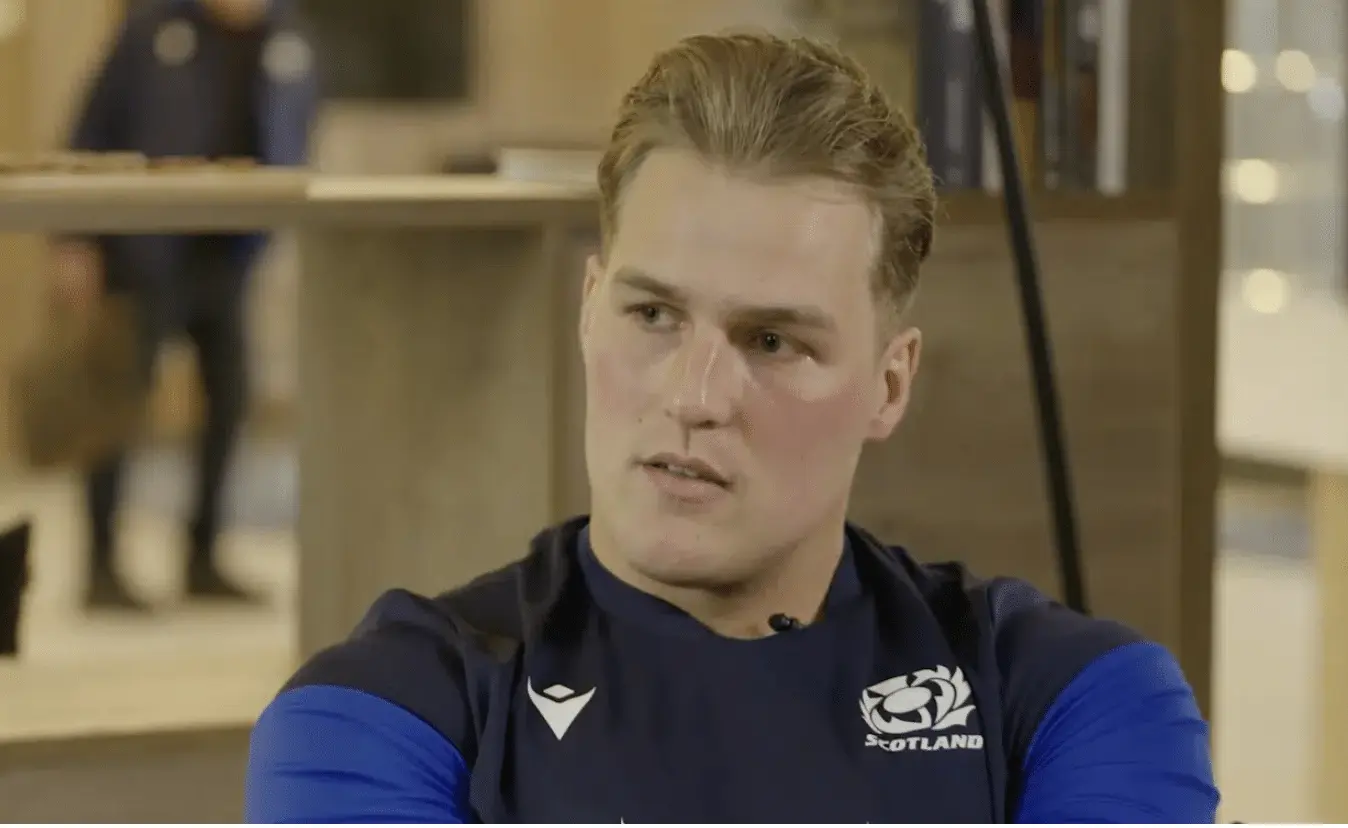

Duhan van der Merwe has made one thing crystal clear — his international future lies firmly with Scotland.
and get the latest rugby news straight to your phone.
Despite finding himself out the team, the destructive winger has firmly shut the door on any future in the green and gold of South Africa. Instead, he’s thrown his full weight behind the nation that gave him a second chance — and a rugby home.
Built Like a Wrecking Ball
At 6ft 4in and sculpted like solid granite, van der Merwe looks engineered to ruin defensive game plans.
With flowing blond locks and bone-crunching carries, he’s the kind of winger who blends comic-book hero aesthetics with real-world destruction — think Johnny Bravo meets Action Man, but with fend-offs that hurt.
Emotion Behind the Power
For all the brute force he brings on the field, there’s a deeply personal story underneath the muscle.
“When I speak about it, I get really emotional because it’s a country that has given me so much when I had nothing,” van der Merwe admitted.
It’s clear Scotland isn’t just a jersey — it’s a lifeline, a home, and a source of pride.
Townsend Backs His Star
Scotland head coach Gregor Townsend isn’t panicking about the winger’s recent struggles, pointing instead to injury disruption.
“Probably more concerning that he’s had a few injuries,” Townsend explained.
“He’s not really had a run of games.”
Townsend highlighted positive signs from recent performances, including flashes of quality against Gloucester and moments of promise in the Hampden derby.
“He’s finding his form… he just needs more games. I believe he’ll be fit this week, which is a boost.”
With the Six Nations looming, Townsend remains confident van der Merwe can fire back into top gear — and remind everyone why he’s one of Scotland’s most feared weapons.
Foreign-born players by nation (2026)
Scotland — 14 foreign-born players (35%)
- Homegrown: 26/40 (65%)
- Foreign-born: 14/40 (35%)
Scotland once again lead the Six Nations for overseas-born representation.
Full list (Scotland)
Nathan McBeth — South Africa (Grandparent)
Pierre Schoeman — South Africa (Residency, 2021)
Ewan Ashman — Canada (Parent)
Elliot Millar Mills — England (Parent)
Josh Bayliss — England (Grandparent)
Jack Dempsey — Australia (Grandparent)
Ben White — England (Grandparent)
Fergus Burke — New Zealand (Grandparent)
Tom Jordan — New Zealand (Residency, 2024)
Rory Hutchinson — England (Grandparent)
Sione Tuipulotu — Australia (Grandparent)
Kyle Rowe — England (Cumulative Residency)
Kyle Steyn — South Africa (Parent)
Duhan van der Merwe — South Africa (Residency, 2020)
Wales — 9 foreign-born players (23.6%)
- Homegrown: 29/38 (76.3%)
- Foreign-born: 9/38 (23.6%)
Wales sit mid-table, with most foreign-born players coming through English development pathways or overseas heritage.
Full list (Wales)
Tomas Francis — England (Grandparent)
Archie Griffin — Australia (Parent)
Ben Carter — England (Residency, 2004)
Freddie Thomas — England (Grandparent)
Olly Cracknell — England (Grandparent)
Josh MacLeod — Monaco (Residency, 2004)
Gabriel Hamer-Webb — England (Parent)
Ellis Mee — England (Parent)
Blair Murray — New Zealand (Parent)
Italy — 8 foreign-born players (24.2%)
- Homegrown: 24/33 (72.7%)
- Foreign-born: 8/33 (24.2%)
Italy continue to benefit from a diverse talent pool, drawing on Argentine heritage and residency-qualified backs.
Full list (Italy)
Pablo Dimcheff — Argentina (Grandparent)
Muhamad Hasa — Albania (Residency, 2014)
Martin Page-Relo — France (Grandparent)
Stephen Varney — Wales (Parent)
Juan Ignacio Brex — Argentina (Grandparent)
Paolo Odogwu — England (Parent)
Montana Ioane — Australia (Residency, 2020)
Matt Gallagher — England (Grandparent)
Ireland — 8 foreign-born players (20%)
- Homegrown: 34/40 (85%)
- Foreign-born: 8/40 (20%)
Ireland remain one of the most homegrown squads in the championship, but several key players — especially in the backline — were born abroad.
Full list (Ireland)
Jeremy Loughman — USA (Parent)
Finlay Bealham — Australia (Grandparent)
Cormac Izuchukwu — England (Parent)
Joe McCarthy — USA (Parent)
Jamison Gibson-Park — New Zealand (Residency, 2019)
Ciarán Frawley — Australia (Parent)
Bundee Aki — New Zealand (Residency, 2017)
James Lowe — New Zealand (Residency, 2020)
France — 7 foreign-born players (15.5%)
- Homegrown: 39/45 (86.6%)
- Foreign-born: 7/45 (15.5%)
France have one of the strongest domestic player bases, but still include a handful of residency-qualified forwards.
Full list (France)
Dany Priso — Cameroon (Residency, 2008)
Uini Atonio — New Zealand (Residency, 2014)
Tevita Tatafu — Tonga (Residency, 2024)
Joshua Brennan — Ireland (Residency, 2005)
Thibaud Flament — Belgium (Born in France)
Emmanuel Meafou — New Zealand (Residency, 2023)
Tom Staniforth — Australia (Residency, 2025)
England — 6 foreign-born players (16.6%)
- Homegrown: 34/36 (94.4%)
- Foreign-born: 6/36 (16.6%)
England have the most domestically produced squad in the tournament, with only a small group born outside the country.
Full list (England)
Bevan Rodd — Scotland (Parent)
Emmanuel Iyogun — Spain (Residency)
Sam Underhill — USA (Parent)
Marcus Smith — Philippines (Parent)
Henry Arundell — Dhekelia (Parent)
Immanuel Feyi-Waboso — Wales (Grandparent)
Ranking: Most foreign-born players (2026)
- Scotland — 14
- Wales — 9
- Italy — 8
- Ireland — 8
- France — 7
- England — 6
TRENDING



LATEST NEWS
LATEST COMMENTS
Loading