Duhan van der Merwe Addresses Springbok Switch Talk After Scotland Snub
Rugby NewsWednesday, 11 February 2026 at 10:03
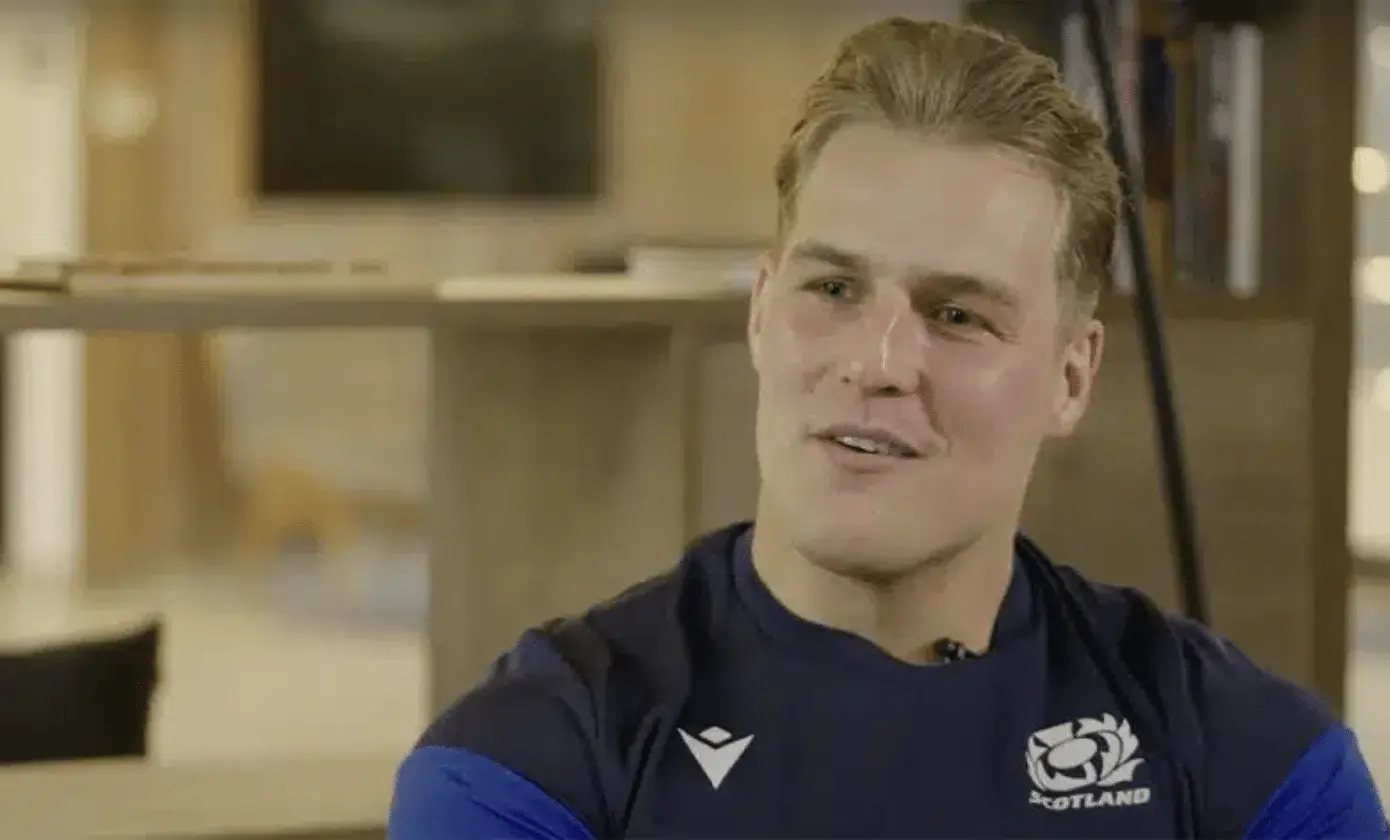

Duhan van der Merwe has drawn a line in the turf – and it’s painted navy blue.
Despite the recent snub, the powerhouse wing hasn’t wavered. If anything, he’s doubled down. The message is crystal clear: there’s no turning back, no second thoughts, no split loyalties. The Springbok jersey? Dead and buried.
Watch the Guinness Six Nations at your local Greene King sports pub.
Green-and-gold is off the table. Permanently.
Van der Merwe has shut the door with force, making it known that his future belongs to Scotland – the country that handed him his shot and backed him to become the wrecking ball he is today.
His bond with Scotland isn’t just about caps and anthems. It’s personal. It’s emotional. It’s forged in big hits, long runs, and moments that shook stadiums.
and get the latest rugby news straight to your phone.
Built Like a Bulldozer
Standing at 6ft 4in and carved like Rustenburg granite, Duhan van der Merwe is a nightmare for defenders. With flowing blond hair and thundering runs, he could pass for a cross between Johnny Bravo and Action Man.
Heart Under the Muscle
Beneath the cartoonish destruction on the pitch lies a genuine emotional connection off it.
“When I speak about it, I get really emotional because it’s a country that has given me so much when I had nothing,” Duhan van der Merwe said.
From Montpellier Misfortune to Edinburgh Glory
After a tough spell at Montpellier – including a failed medical – Edinburgh took a chance on him. That decision changed the course of his career.
“I went over as a young boy and people don’t understand how hard it is, leaving your family behind, leaving everything behind, going to a country where you don’t know how things work,” he explained.
“Initially, my English wasn’t good at all. It was tough. People don’t understand how hard that transition is. It’s not easy, no one has guaranteed me: ‘Oh, Duhan, if you move over at the age of 22 you’ll be Scotland’s top try-scorer, you’ll have played 49 games for Scotland, you’ll go on a second Lions tour.’
“People don’t see the amount of hard work and sacrifice you put in because I wouldn’t be sitting here without it.”
Poll:
Scottish Legend
Now Scotland’s all-time top try-scorer and a two-time British & Irish Lion, Duhan van der Merwe has cemented his place in Scottish rugby folklore – and he’s not about to swap allegiances anytime soon.
EDITORS PICKS:
- 2026 Six Nations goes behind paywall for the first time next month
- The longest bans in rugby history (Ranked 10-1)
- England’s Six Nations WAGs includes doctor and underwear model
- Ireland Rugby star Sexton joins police in surprise career shift
- Viral clip shows why Bundee Aki has been sent home from Ireland squad
Who has the most foreign-born players? 2026 Six Nations
The Six Nations has always been rooted in tradition — but in the modern era, international squads are increasingly shaped by migration, ancestry, and residency eligibility.
In 2026, foreign-born players remain a major part of the championship picture, although the overall numbers have fallen sharply compared to recent years.
Scotland — 14 foreign-born players (35%)
- Homegrown: 26/40 (65%)
- Foreign-born: 14/40 (35%)
Scotland once again lead the Six Nations for overseas-born representation.
Full list (Scotland)
Nathan McBeth — South Africa (Grandparent)
Pierre Schoeman — South Africa (Residency, 2021)
Ewan Ashman — Canada (Parent)
Elliot Millar Mills — England (Parent)
Josh Bayliss — England (Grandparent)
Jack Dempsey — Australia (Grandparent)
Ben White — England (Grandparent)
Fergus Burke — New Zealand (Grandparent)
Tom Jordan — New Zealand (Residency, 2024)
Rory Hutchinson — England (Grandparent)
Sione Tuipulotu — Australia (Grandparent)
Kyle Rowe — England (Cumulative Residency)
Kyle Steyn — South Africa (Parent)
Duhan van der Merwe — South Africa (Residency, 2020)
Wales — 9 foreign-born players (23.6%)
- Homegrown: 29/38 (76.3%)
- Foreign-born: 9/38 (23.6%)
Wales sit mid-table, with most foreign-born players coming through English development pathways or overseas heritage.
Full list (Wales)
Tomas Francis — England (Grandparent)
Archie Griffin — Australia (Parent)
Ben Carter — England (Residency, 2004)
Freddie Thomas — England (Grandparent)
Olly Cracknell — England (Grandparent)
Josh MacLeod — Monaco (Residency, 2004)
Gabriel Hamer-Webb — England (Parent)
Ellis Mee — England (Parent)
Blair Murray — New Zealand (Parent)
Italy — 8 foreign-born players (24.2%)
- Homegrown: 24/33 (72.7%)
- Foreign-born: 8/33 (24.2%)
Italy continue to benefit from a diverse talent pool, drawing on Argentine heritage and residency-qualified backs.
Full list (Italy)
Pablo Dimcheff — Argentina (Grandparent)
Muhamad Hasa — Albania (Residency, 2014)
Martin Page-Relo — France (Grandparent)
Stephen Varney — Wales (Parent)
Juan Ignacio Brex — Argentina (Grandparent)
Paolo Odogwu — England (Parent)
Montana Ioane — Australia (Residency, 2020)
Matt Gallagher — England (Grandparent)
Ireland — 8 foreign-born players (20%)
- Homegrown: 34/40 (85%)
- Foreign-born: 8/40 (20%)
Ireland remain one of the most homegrown squads in the championship, but several key players — especially in the backline — were born abroad.
Full list (Ireland)
Jeremy Loughman — USA (Parent)
Finlay Bealham — Australia (Grandparent)
Cormac Izuchukwu — England (Parent)
Joe McCarthy — USA (Parent)
Jamison Gibson-Park — New Zealand (Residency, 2019)
Ciarán Frawley — Australia (Parent)
Bundee Aki — New Zealand (Residency, 2017)
James Lowe — New Zealand (Residency, 2020)
France — 7 foreign-born players (15.5%)
- Homegrown: 39/45 (86.6%)
- Foreign-born: 7/45 (15.5%)
France have one of the strongest domestic player bases, but still include a handful of residency-qualified forwards.
Full list (France)
Dany Priso — Cameroon (Residency, 2008)
Uini Atonio — New Zealand (Residency, 2014)
Tevita Tatafu — Tonga (Residency, 2024)
Joshua Brennan — Ireland (Residency, 2005)
Thibaud Flament — Belgium (Born in France)
Emmanuel Meafou — New Zealand (Residency, 2023)
Tom Staniforth — Australia (Residency, 2025)
England — 6 foreign-born players (16.6%)
- Homegrown: 34/36 (94.4%)
- Foreign-born: 6/36 (16.6%)
England have the most domestically produced squad in the tournament, with only a small group born outside the country.
Full list (England)
Bevan Rodd — Scotland (Parent)
Emmanuel Iyogun — Spain (Residency)
Sam Underhill — USA (Parent)
Marcus Smith — Philippines (Parent)
Henry Arundell — Dhekelia (Parent)
Immanuel Feyi-Waboso — Wales (Grandparent)
Ranking: Most foreign-born players (2026)
- Scotland — 14
- Wales — 9
- Italy — 8
- Ireland — 8
- France — 7
- England — 6
TRENDING



LATEST NEWS
LATEST COMMENTS
Loading