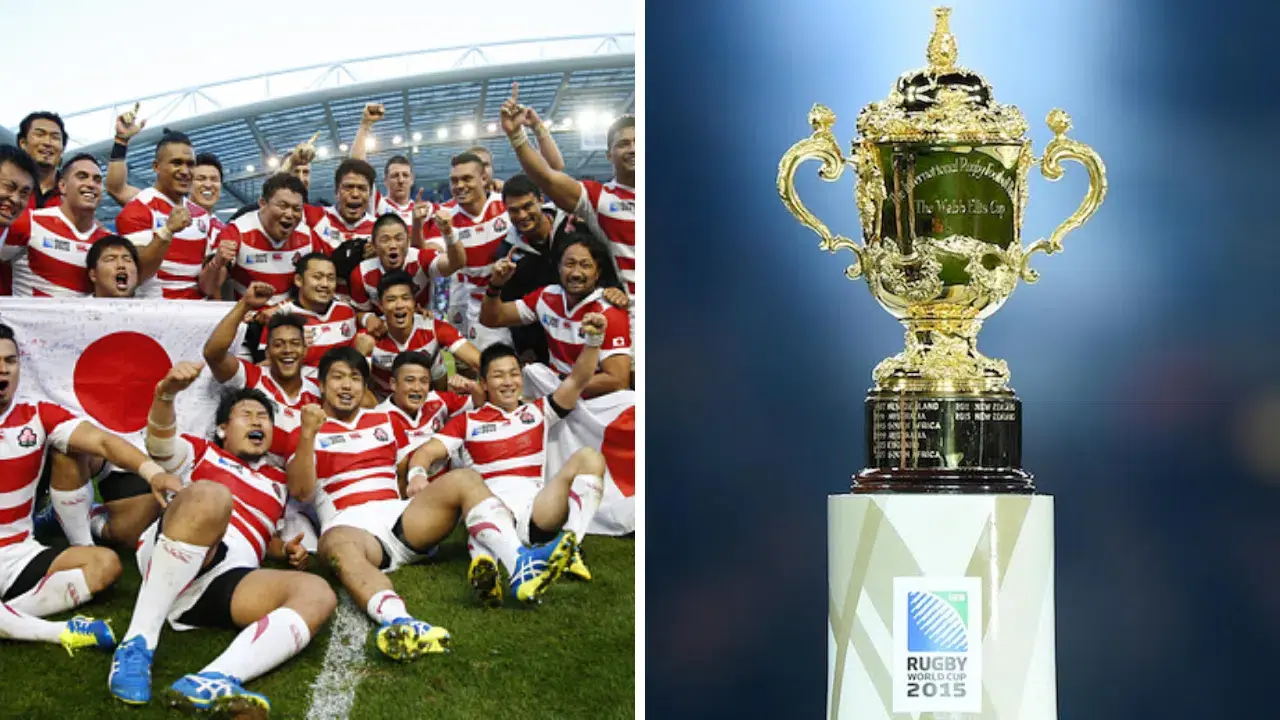

The Rugby World Cup has played witness to some of the greatest upset victories in the history of the sport. There are few better feelings than willing on the underdogs, and seeing them topple the favourites in an triumphant yet unexpected win.

The Webb Ellis Cup - Photo mandatory by-line: Gareth Davies/Pinnacle - Tel: +44(0)1363 881025 - Mobile:0797 1270 681 - VAT Reg No: 183700120 - 31/10/2015 - SPORT - RUGBY UNION - RUGBY WORLD CUP 2015 FINAL - New Zealand v Australia - Twickenham Stadium, Twickenham, London, England.
The 'make-or-break' stage of a Rugby World Cup makes these upset victories to be even more spectacular. Giant-slayings are somewhat of a rarity at rugby's pinnacle competition, but when the titan is felled by a plucky underdog, iconic moments are created that will be told for generations.
From Brighton to New Zealand, and with 36 years of history to choose from, here are the Top 5 Rugby World Cup upsets.
1. South Africa 32 - 34 Japan: 2015 Rugby World Cup

There could be no better way to get this list underway, than to look back on the heroic tale of the 'Brighton Miracle'. The opening match of Pool B at the 2015 Rugby World Cup, saw the titans of South Africa take on Japan's Brave Blossoms, in what most expected would be a one-sided victory for the imposing Springboks.
However, with none other than Eddie Jones as Head Coach, Japan had conjured a masterful gameplan and took the fight to South Africa from the off. Japan had only ever recorded a single Rugby World Cup victory prior to this game, in a 52-8 shut-out against Zimbabwe in 1991.

Yet Jones was prepared. The Australian previewed the match by saying that this "could be a day to remember for Japanese rugby." Jones taught his players the art of the chop tackle, which proved an effective method of halting the giant Springbok carriers.
The 'Boks tried to run over their considerably smaller opponents, yet Jones' defensive ingenuity ensured that his side could cut the attacking momentum out from under the legs of the bruising South Africans. The two sides traded first half blows, as Francois Louw opened up the scoring for the Springboks before Japan Captain Michael Leitch responded to keep his side in the match.

BRIGHTON, ENGLAND - SEPTEMBER 21: Japan captain Michael Leitch addresses the media during a Japan Press Conference at the Hilton Hotel on September 21, 2015 in Brighton, England. (Photo by Mike Hewitt/Getty Images)
A 12-10 half-time score saw Japan remain in touching distance of their opponents, and Eddie Jones' side refused to roll over despite the second half pressure. Full back Ayumu Goromaru slotted five penalties, which counteracted the Bok's tries from Bismarck du Plessis, Lodewyk de Jager and Jan Strauss. Goromaru's phenomenal try in the 69th minute then levelled up the scores, and the previously impossible task seemed almost achievable.
Handre Pollard's 73rd minute penalty never withered the Blossom's hope, as they kept fighting with intense chop tackles until the very end. And in the final play of the match, time stood still, as replacement winger Karne Hesketh fought his way into the corner, to wrap up an unbelievable victory for Japan.

during the 2015 Rugby World Cup Pool B match between South Africa and Japan at the Brighton Community Stadium on September 19, 2015 in Brighton, United Kingdom.
Japan had toppled the two-time Rugby World Cup winners, in just their second ever win at a Rugby World Cup. The spectators in the Brighton Community Stadium left the match firm believers in miracles, after this incredible victory that will long be remembered.
2. Wales 34 - 38 Fiji: 2007 Rugby World Cup
The biggest upset victory of the 2007 Rugby World Cup, saw Fiji defeat Wales in a decisive match in Pool B. Australia had already stamped their name on the quarter-finals, with the second placed slot in the pool still there for the taking. The stage was set in Nantes, with the pundits expecting to see a tough contest, yet backed Wales to come out overall victors.
Wales brought a star-studded squad with them to France, as the likes of Shane Williams, Alix Popham and Alun Wyn Jones ran out at the Stade de la Beaujoire. Wales Captain Gareth Thomas led a resounding rendition of 'Old Land of My Fathers', as the capacity crowd was made up of predominantly Welsh support, who had made the short trip across the English Channel.
Yet the Welsh confidence took a knock, as the Fijians performed a fearsome 'Cibi' war dance to prelude the match. The Flying Fijians were not here to make up the numbers, and they took an immediate intense fight to Wales from the off. Fijian flanker Akapusi Qera, winger Vilimoni Delasau and lock Senikavika Leawere opened up the scoring with a blitz of three unanswered tries in the first 25 minutes.
Wales were stunned by this onslaught, and managed to scrape together a first half try through Alix Popham before the break. Head Coach Gareth Jenkins must have given the team talk of his career at half time, as the Welshmen answered with three tries within eleven minutes of the re-start. Shane Williams, Gareth Thomas and Mark Jones took Wales back into the lead, as Fiji looked to have exhausted their arsenal in the first 40 minutes.
Yet consistent kicking from Nicky Little kept Fiji within touching distance of their opponents, as he slotted four crucial penalties to bring the sides level. However, the Pacific Islanders seemed to have succumbed to burn-out, and the experienced heads of Wales looked set to prevail. Welsh flanker Martyn Williams crossed over for a 73rd minute try, taking the match to 34-31 with the sands of time running out for Fiji.
Four minutes remained, and this end-to-end fixture took it's final twist. Delasau made a darting run for the line, yet was halted inches short by Martyn Williams. The exhausted Welsh guarding at the ruck presented a golden opportunity for Fijian glory, with prop Graham Dewes driving over for the memorable win.
Fiji would eventually be eliminated in the following round, as they were drawn against that year's champions South Africa. However, the heroics in Nantes will live long in the memory of Fiji, and stands a testament to the progression of rugby in the Pacific Islands.
3. France 14 - 19 Tonga: 2011 Rugby World Cup
In 2011, soon-to-be Rugby World Cup finalists New Zealand and France, were both drawn into Pool A. In identical circumstances of the upcoming 2023 Rugby World Cup, the All Blacks and Les Blues were presumed favourites to progress out of their 'Group of Death'. However, Pacific Islanders Tonga were out to disrupt the order, and produced the upset of the competition when they met France in the final Pool Stage round.
A bonus point win for Tonga would have levelled their points total with France, with the decisive second placed spot in the group being settled on points difference. The Tongans were all too aware of this, and brought an ignited fire to Wellington's Westpac Stadium. A spot in the quarter-finals was in their hands, and they had all intentions on joining the All Blacks out of the Pool.
The match was a ferocious sparring match, as neither side would give an inch in the physical battle of attrition. Precious points were found by the boot, as Dimitri Yachvili and Kurt Morath kept the score-boards ticking over for their sides. The Pacific Islanders found the opening try, as the blue wall was depleted long enough for left winger Sukanaivalu Hufanga to score.
Then the foundations were re-built, and the slogging contest continued. Tonga left it all out on the pitch, with France beaten black and blue regardless of their kit colour. France were resilient, and with their legendary captain Thierry Dusatoir pushing them forward, Les Bleus grabbed an 80th minute try, and the all-important losing bonus point. Vincent Clerc ensured that his country would progress out of the Pool, yet Tonga came away with an unforgettable victory over France.
France Head Coach Marc Lievremont gave his side a scathing dressing-down in the post match media. Dusatoir agreed, and believed that his side were far below standards against the Tongans. Despite the French excuses, they still progressed and left New Zealand with silver medals. The Sea Eagles were unfortunate to not progress out the Pool stage, yet the 14-19 victory will long be remembered as a another highlight in the entertaining history of Pacific Island rugby.
4. Wales 13 - 16 Western Samoa: 1991 Rugby World Cup
The original and best for the Pacific Islanders, as this upset announced Oceania's intentions on the world stage. In what would be a trailblazing template for the aforementioned victories of Tonga and Fiji, Western Samoa achieved the initial upset victory, over an established rugby nation on the grandest stage.
The nation of Wales consider this loss to be arguably the darkest time in the history of their rugby team. One of the most prestigious and proud teams were undone by the ultimate underdogs, with the odds firmly stacked against them. This defeat was made all the more worse, as it took place in Cardiff Arms Park, the historic ground in the heart of the Welsh capital.
This match would go on to have lasting consequences, as Western Samoa finished second in the group, and progressed into the knock-out stages with the Wallabies. Wales were rightfully dejected, as they were outperformed by a side who had ventured to their maiden Rugby World Cup. The Western Samoan team was bolstered with the likes of now Bristol Bears Head Coach Pat Lam, former All Black Frank Bunce and Apollo Perelini who lived up to his moniker as 'The Terminator',
Western Samoa lived up to their reputation as tough tacklers, stopping the Welsh momentum firmly in it's tracks. Wales halfbacks Robert Jones and Mark Ring were targeted, as earth-shaking collisions could be heard to the very back of the Cardiff Arms Park rafters. Western Samoa found the way to the try-line through To'o Vaega and Sila Vaifale.
Wales managed to get a hold of the game in the latter stages, with Arthur Jones and Ieuan Evans scoring tries for the hosts. However, the all-important points came from the boot of Mathew Vaea, who was far more accurate than the heavily hit Mark Ring. Western Samoa maintained their structure, and saw out the remainder of the match with resilient defence, despite the best efforts of an illustrious Wales side.
Reports from that day state how it was quipped "Thank heavens Wales weren't playing the whole of Samoa". Wales, who had come away from the 1987 Rugby World Cup with bronze medals, were now eliminated by a nation with 168,000 people.
This match stands the test of time, with it's historical significance marking it as the first Rugby World Cup upset, an originator of it's kind.
5. Japan 19-12 Ireland: 2019 Rugby World Cup
We round off this list by looking at the most recent Rugby World Cup upset, with Japan's Brave Blossoms starting and finishing this article off in style. As magnificent as the Brighton Miracle was, it was an even more joyous occasion seeing Japan strike lightning for the second time at a Rugby World Cup.
Japan's triumph over Ireland held greater significance, as it took place in front of over 47,000 fans on home soil. Hosting the 2019 Rugby World Cup in Japan was a bold statement towards the progression of the Blossoms, as they topped the group which also included Scotland, Samoa and Russia.
Former All Black Jamie Joseph took the reigns as Japan's Head Coach, his side were once again the underdogs, as they lined up against the Number Two ranked side in the world. Ireland had claimed the Six Nations Grand Slam in 2018, yet had their momentum hindered in the World Cup year. Ireland bolstered a squad brimming with talent, yet the public opinion on Head Coach Joe Schmidt had begun to sour as success dwindled.
The men from the Emerald Isle took a strong start, as Garry Ringrose charged in for the match's opening score after 14 minutes. The absence of Johnny Sexton meant that Jack Carty took up kicking duties, however, the Connacht man left his shooting boots in the changing rooms for the first attempt. Ireland followed this up with Rob Kearney's try, and Carty's conversion saw all signs begin to point to a fore-gone conclusion.
A tide-turning moment was the arrival of Michael Leitch. The Japan Captain was left out of the starting line-up, and came on after half an hour to an eruption of applause. Japan maintained their unrelenting attitude and were awarded with penalties, and Ireland's lead was depleted to just 12-9 at halftime. Ireland began to feel an eery sense of Deja vu as they emerged for the second half, they had seen this all before with the Springboks and knew that they had a fight on their hands.
Yet Ireland did not just battle the 23 man squad, they had to fend of the army of red and white striped jerseys that surrounded them in Fukuroi. Any non-Irish neutral was backing the Japanease, which caused an almighty roar when Kenki Fukuoka scored a try on the hour mark. Japan had etched in front, and the neat kicking of Yu Tamura made certain that they would not lose the lead.
Ireland gained possession of the ball on their own try line, and had a long way to go with the 'clock in the red'. They were within one score of success, and yet knew that they had an unobtainable mountain to summit in the Shizuoka Stadium Ecopa. The full time gong had sounded, and Ireland opted to kick the ball deep into Japan's territory. However, the ball bounced out, and the Brave Blossoms rejoiced once again.
TRENDING

LATEST NEWS
LATEST COMMENTS
Loading